24 Hours of Le Mans '1923–30
24 Hours of Le Mans '1923

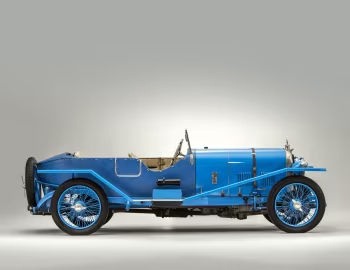


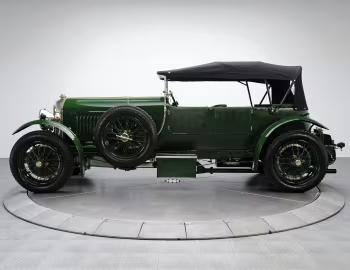
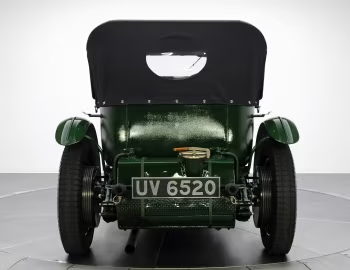
The 1923 24 Hours of Le Mans, officially the 24 Hours Grand Prix of Endurance, was the inaugural Grand Prix of Endurance, and took place on 26 and 27 May 1923. For this first endurance trial there were 37 entries, all submitted by the manufacturers rather than individual drivers. Only the 2-car Avions Voisin team were late scratchings. With the cars all painted in their national racing colours, there was a predominance of French blue cars except for a single green Bentley from Great Britain and two Belgian Excelsiors in yellow. The cars were assigned their numbers in the order of their engine size. Many of the car models were co-identified with the French CV-system of automotive horsepower tax. However, there was no official victory for them as this event was the first part of three consecutive annual races, for the Rudge-Whitworth Triennial Cup, where the ultimate winner would be the manufacturer whose best car exceeded their nominated target distance by the greatest margin.
- Regulations:
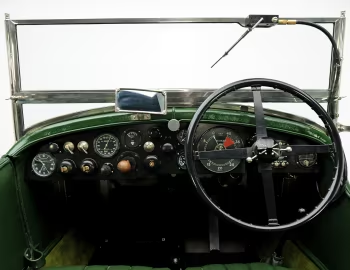
The final regulations for the event were not completed by Charles Faroux and the Automobile Club de l'Ouest (ACO) until February 1923. All cars had to be standard 4-seater production models, except those under 1100cc which could be 2-seaters where at least thirty cars had been built. The vehicle had to carry 60kg lead ballast for each passenger space aside from the driver. A maximum of two drivers were allowed (but not riding together), and they alone could replenish the fluids (petrol, oil and water), although there was no minimum distance between refills as in later years. The fuel was to be supplied by the ACO. Engines had to be turned off at pit-stops, and only re-started with an onboard starter. All cars had to have standard touring equipment, such as wheel wings, hood (if a convertible), running boards, headlights, a rear-view mirror and ‘warning devices’ (horn). None of the entered cars had window-wipers. There was an hors course rule such that every car had to meet a certain ratio of their minimum distance at the 6, 12, and 18-hour marks or face disqualification. The ratios were 80%, 85% and 90% respectively. The final minimum distances were on a sliding scale based on engine capacity that were kept deliberately lenient for the first race.


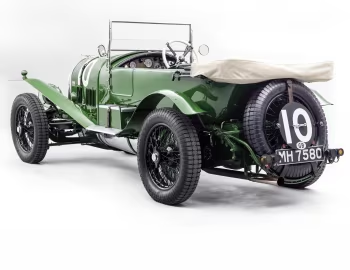
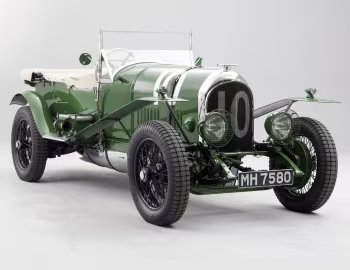


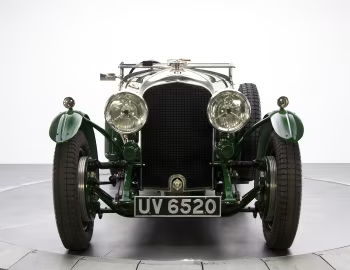


24 Hours of Le Mans '1930

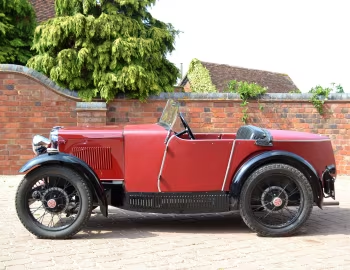


The 1930 24 Hours of Le Mans was the 8th Grand Prix of Endurance that took place at the Circuit de la Sarthe on 21 and 22 June 1930. It saw the first appearance of a German car and the first entry from female drivers.
WheelsAge.org '2005–pr.