Image specifications:

  • Resolution: 940×630 @ 72×72 DPI 33.16×22.23cm
  • Filesize: 154.79 KB
  • Added by: Wheels&Tracks , 6 years ago
  • Picture status: Accepted

All images have their owners.

If you think that the users of the site made a mistake by posting this image in this section, it would be nice if you wrote about it in the comments and pointed out the error.

Discuss anything and just talk about cars and not only can you on the forum.

Comments

6 years ago
Wheels&Tracks

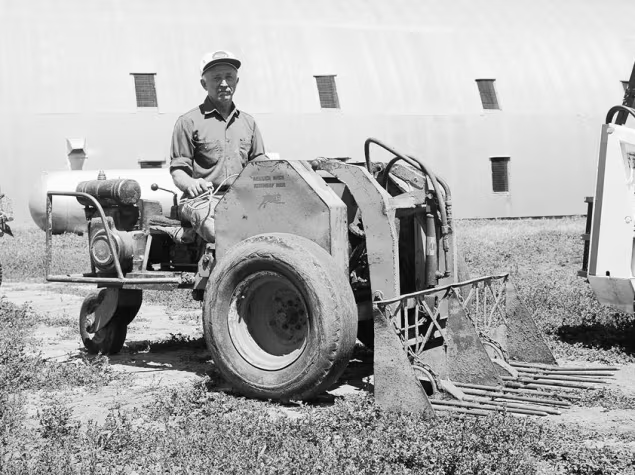
local turkey farmer Eddie Velo.

6 years ago
Wheels&Tracks

It all started with turkey manure.

In 1957, brothers Cyril and Louis Keller of Rothsay, Minnesota, invented the first skid-steer, in response to a turkey producer’s need to clean out his barn, and ultimately disrupted the construction equipment market with their compact loader.

Cyril and Louis owned and operated Keller Manufacturing in Rothsay, a fabricating and repair shop. Local farmers often called on the inventive brothers to repair equipment such as plows, diggers and cultivators. They also manufactured snowblowers, plowshares and hay wagons.

One such customer, Eddie Velo who was a pioneer in the turkey industry, turned to the brothers in 1956 for their help. Velo was going from small flocks to a large production and needed a piece of equipment that could clean up large amounts of manure around posts set every eight feet apart in his two-story barns. The standard loader tractors at the time were too large, had limited maneuverability and were too heavy to operate on the second floor of his barn.

“It took a little time to work out the design,” Cyril Keller said. “Eddie agreed to pay a fair price if the loader worked, and if it didn’t work, he would just pay for the materials and we were out our time.”

That first prototype was a small, three-wheeled machine with a belt-driven transmission. It consisted of mostly manufactured parts, car wheels, a 6.6hp Kohler engine and a transmission from a Plymouth, and a few scrap parts from unusual sources.

“We were having trouble with the teeth bending on the manure fork, and were trying to work out a solution when our local police officer stopped by the shop,” said Cyril. “He left and came back in a little while with bars from the old jail. They were made of high carbon steel so they wouldn’t bend.” Problem solved.

The small loader’s left and right wheels were designed to act independently and were steered by left and right levers, rather than a steering wheel allowing the machine to skid when steered in opposite directions. “The center of the machine went around itself, and that’s what made it so important,” Cyril said.

The Kellers followed Eddie’s use of the loader, making only minor changes and modifying from a belt to a patented clutch drive system. By late 1958, six more Keller loaders were built and sold to area poultry farms, but the brothers were having trouble finding funding to mass produce their invention. With only one loader left, they were invited by Les Melroe of Melroe Manufacturing Company, Gwinner, North Dakota, to exhibit in the Melroe booth at the 1958 Minnesota State Fair.

Interest in the skid-steer was so great after the fair, Keller said, that Melroe offered to manufacture the loader, and it was agreed that Melroe would have exclusive manufacturing rights and pay the brothers on a royalty basis. The brothers also joined the company with Louis working on developing and refining the loader design and Cyril hitting the road selling.

“I traveled 50 to 60,000 miles per year in my pickup with the loader, setting up dealers and training them how to operate the machine,” Louis Keller said. “They couldn’t sell it without knowing how to use it. Once I demonstrated and they actually operated it, the sales guys were happy because then they were just bringing in the commissions. It worked out perfect.”

As Cyril traveled across North America and Europe, the loader grew in popularity, and market demands began to shape the machine. “I was listening to the farmers and the operators,” Cyril said. “I would give that feedback to Louis who would improve the designs based on customer input.”

https://ironsolutions.com/agriculture-equipment-value-guides/the-first-skid-steer/

5 months ago
Wheels&Tracks

The Keller brothers operated a blacksmith shop in Rothsay, MN, and designed and built a three wheel machine for a customer who was looking for a way to speed the task of cleaning the barns on his turkey farm. The Kellers’ solution was a machine that was lightweight, maneuverable and had enough power to handle the barn cleaning work. There was no other machine like it. Although the loader worked well for barn cleaning and the turkey farmer was pleased with its performance, the Kellers saw several changes that could make their invention even better. They went back to work and made several changes, adding a clutch drive transmission. In 1957, the Kellers patented the loader’s clutch design and built several machines which they sold to nearby customers.

The new machine clearly had great potential for other farm and construction applications, but the Kellers lacked the resources to produce and market large numbers of machines. As they considered what their next step should be, the Melroe Manufacturing Co., a farm equipment manufacturer in Gwinner, ND, entered the picture. After seeing the Keller loader, the Melroe brothers, who owned the company, were immediately interested and offered the Kellers space to show their loader in the Melroe exhibit at the 1958 Minnesota State Fair. The machine drew so much attention, the Melroes and the Kellers struck a deal, and the Kellers moved to Gwinner, setting the stage for production of the M 60 Melroe Self Propelled Loader later that year.

The small loader proved to be a viable product. Improvements came quickly and the second model – the M 200 – had a more robust lift arm assembly and updated two cylinder engine.

To be successful in the marketplace, it was determined that the new product needed improved traction and something other than a rear caster wheel for maneuvering. The design team added a rear axle and changed the machine’s weight distribution ratio. Extending the length six inches added stability but still enabled the machine to turn in its tracks. The result was a loader that, when empty, had 70 percent of its weight on the rear wheels, 30 percent on the front wheels. When loaded, the ratio reversed, providing excellent traction and maneuverability. In 1960, the new machine was introduced as the M 400, the world’s first compact skid steer loader.

Durability continued to be an issue that nearly scrapped the fledgling Melroe loader project. But in 1961, the brothers set about to develop an entirely new design with enclosed chain cases and better lubrication. The improved model was introduced in 1962 as the M 440 and became the skid steer loader blueprint that would be used for many years and remains a basic design element in today’s skid steer equipment.

The same year, the Bobcat brand name and logo were introduced. The Bobcat, an animal known for being tough, quick and agile, seemed to perfectly describe the Melroe skid steer loader.

https://undergroundinfrastructure.com

To be able to post a comment, you must create an account or sign in using social networks account

WheelsAge.org '2005–pr.