Image specifications:

  • Resolution: 2000×1443 @ 300×300 DPI 16.93×12.22cm
  • Filesize: 1.8 MB
  • Added by: uri1974 , 8 years ago
  • Picture status: Accepted

All images have their owners.

If you think that the users of the site made a mistake by posting this image in this section, it would be nice if you wrote about it in the comments and pointed out the error.

Discuss anything and just talk about cars and not only can you on the forum.

Comments

7 years ago
Wheels&Tracks

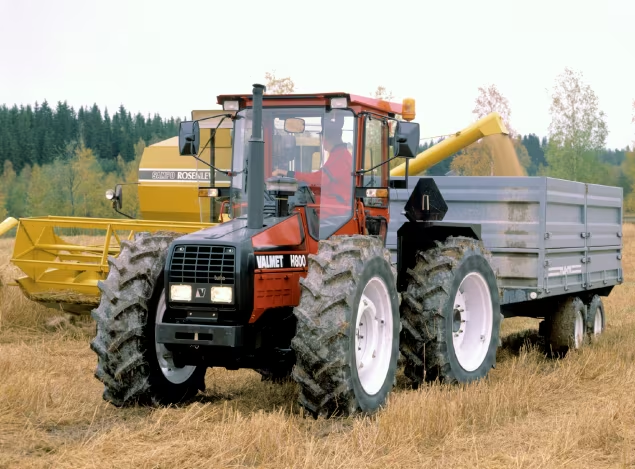
The first model to come with a complete hydrostatic transmission was the Valmet H800.

In the mid-1980s Valmet’s Tractor Group established a special project team to begin work on introducing a tractor concept that had been sourced from outside the company to serial production. This tractor was very interesting. It was articulated in the middle, and all four wheels were the same size. The cab was situated in the front half along with the engine.

Remarkably, the steering wheel, pedals and seat formed a pulpit that could be rotated 180-degrees from within the cab. This allowed the tractor to be driven just as easily in both directions. Accordingly, the loader was situated in the rear half, allowing the tractor to be used just like a wheel loader, since the chassis was articulated and visibility to the loader excellent.

The H800 was powered by a Valmet 411 DS turbocharged four-cylinder 4.4-litre engine that produced 110 horsepower (DIN). The transmission was fully hydrostatic. At the time, suppliers of hydraulic components began offering rotary piston engines situated at the wheel hub. The engine’s displacement

could also be varied. At low driving speeds a large displacement was used for each rotation of the wheel, whereas at high speeds the displacement was reduced, thus controlling the amounts of oil flow. There were three hydraulically selectable speed ranges, and the forward-reverse shuttle occurred by switching the direction of the flow. Naturally, the speed could be adjusted steplessly.

The H800 had separate pumps for both the front and rear axles. There were no mechanical transmission components between the engine and the wheels. Further reinforcing the revolutionary nature of this tractor, it featured load-sensing hydraulics whose variable displacement pump had an

output of 140 l/min. Four external hydraulic valves were standard.

The Valmet H800 was unveiled as a concept tractor at the SIMA exhibition in Paris in spring 1987 and received a lot of attention. Subsequently work continued on introducing it into serial production. Since most of the design work had been done by an outside project team, the documentation was incompatible with the factory’s own methods, which caused difficulties. When the entire global tractor industry was hit by the depression in the early 1990s, Valmet was forced to abandon the H800 programme.

A single H800 has nevertheless carried out yard work outside the Suolahti factory for the past twenty years – proof that the concept does indeed work.

Hannu Niskanen

The Valmet H800 was a truly advanced tractor. It produced 110 horsepower and its hydrostatic transmission had three speed ranges: 0–11, 0–17 and 0–30 km/h. The standard tyre size was 16.9-34. There was no mechanical PTO, but a hydraulic powered 540 or 1000 rpm PTO was optionally available at both the front and back. The tractor weighed 4,400 kilos, it had a wheelbase of 2,500 mm and its turning circle was 4,100 mm.

https://valtrateam.valtra.com/wp-content/uploads/2018/05/Valtra-Team_UK-2008-2.pdf

To be able to post a comment, you must create an account or sign in using social networks account

WheelsAge.org '2005–pr.