Image specifications:

  • Resolution: 2500×1668 @ 72×72 DPI 88.19×58.84cm
  • Filesize: 1.02 MB
  • Added by: Wheels&Tracks , 2 years ago
  • Picture status: Accepted

All images have their owners.

If you think that the users of the site made a mistake by posting this image in this section, it would be nice if you wrote about it in the comments and pointed out the error.

Discuss anything and just talk about cars and not only can you on the forum.

Comments

2 years ago
Wheels&Tracks

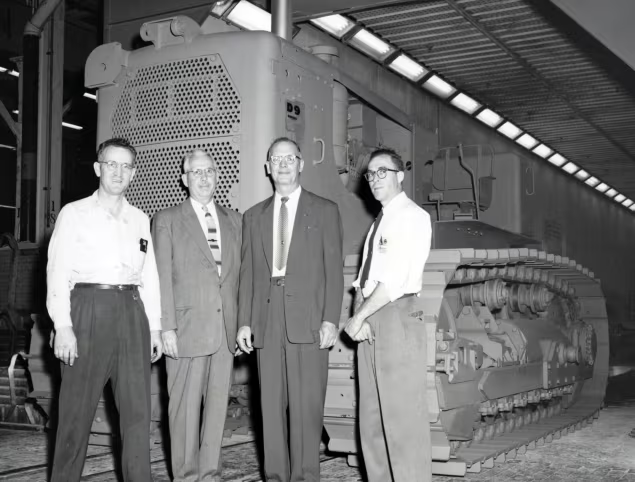
Walt Dunbar had worked at Caterpillar since 1940, and he had seen countless innovations in the Caterpillar product line, but nothing quite compared to the earthmoving leviathan he was about to help create. In 1955 Dunbar was the superintendent of Erection and Testing in Building LL in East Peoria, and in May of that year he was called upon to supervise what was the most important development in Caterpillar track-type tractors since the launch of the first diesel machine in 1931: Walt would be personally responsible for overseeing the assembly of the first D9 production model.

The D9 was a 29-ton monster of a machine, making it the largest and most powerful dozer in the world by a substantial margin, and it represented years of large tractor research and development by Caterpillar people such as Walt. His team described the new D9 as a "light-footed giant" that was used on jobs that were too tough and too rugged for other tractors. The D9 was made to be used in virtually every tough track-type tractor application around the world, particularly in general construction, logging, pipelaying, mining and quarrying.

One of the main innovations found in the D9 was the use of a turbocharger in the diesel engine. Powered by exhaust gases, the turbocharger provided additional horsepower and quieter operation that led to greater operator comfort.

With the first D9 off the line and on its way to a customer, Walt and his team felt a great sense of pride and achievement that must have been shared by all Caterpillar employees that day. Chuck Woodley, vice president, offered his congratulations to the team: "To Walt and all Caterpillar employees at all plants who had any part in the production of the D9, I extend my warmest commendation. Such smooth coordination and cooperation throughout its development and production reaffirms the great Caterpillar tradition.”

Walt’s Caterpillar career would lead him to many more opportunities and cities, including Glasgow, Scotland; Milwaukee, Wisconsin; Mossville, Illinois; and Davenport, Iowa. He retired in 1988 after 48 years of service to the company. But when it was all over, what he said he’d never forget was his time making history with the Caterpillar D9.

https://www.caterpillar.com/en/company/history/1950.html

To be able to post a comment, you must create an account or sign in using social networks account

WheelsAge.org '2005–pr.